
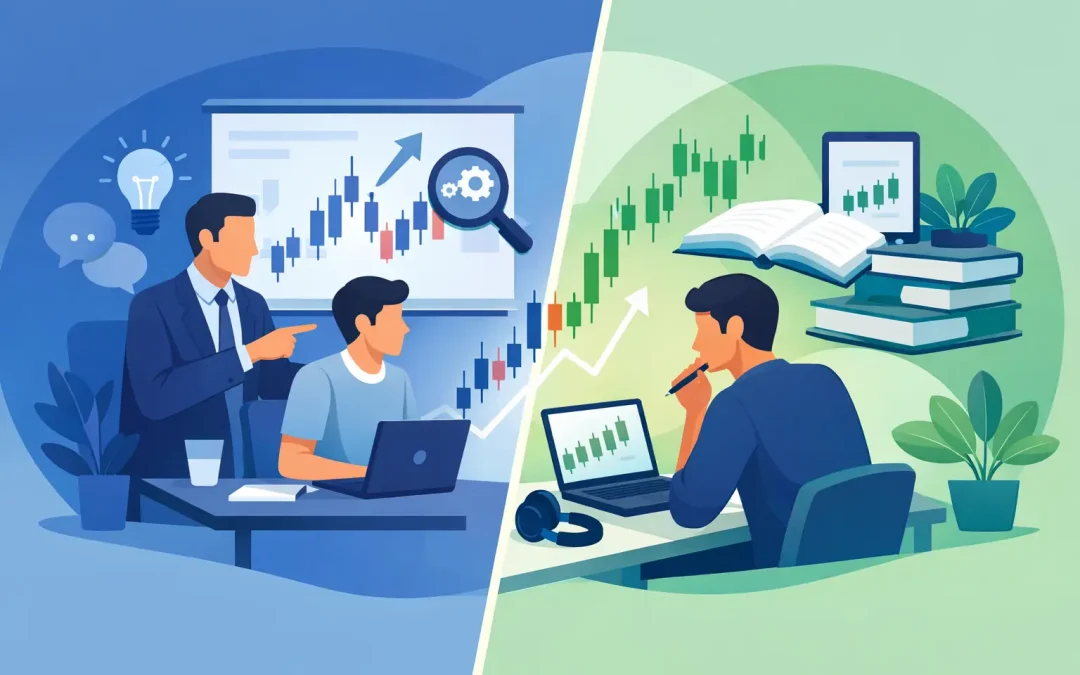
A losing trade is not always the problem. The real damage often comes afterwards: changing the strategy, doubling the risk, watching five more videos, then starting again with a different indicator. That cycle is why the question of forex coaching vs self study matters. You are not simply choosing how to learn charts. You are choosing whether you will build a process that holds up when money, uncertainty and emotion are involved.
Self study can produce capable traders. Coaching can accelerate progress and expose blind spots that solo learners cannot see. Neither route is a magic answer. The right choice depends on your current skill level, budget, available time and, most importantly, whether you can follow rules without someone challenging you when you drift.
Forex Coaching vs Self Study: The Real Difference
The difference is not that coaching gives you a secret strategy while self study gives you theory. There are no guaranteed shortcuts in forex. A serious coaching programme should teach the same foundations a committed independent trader needs: market structure, trade selection, position sizing, risk control, journalling and review.
What changes is the feedback loop. With self study, you decide what to learn, which material is credible, when to practise and how to diagnose poor results. With coaching, an experienced trader helps you organise that process. They can look at your trade idea and point out that your entry was acceptable but your stop placement made no sense, or that you were trading a setup outside the conditions your plan allows.
That distinction becomes valuable because most struggling traders do not fail from a lack of information. They fail from inconsistent application. They know they should manage risk, but take oversized positions after a loss. They know their setup, but enter before confirmation because they fear missing the move. More content will not automatically correct that behaviour.
What Self Study Does Well
Self study is the most flexible route. You can work around a job, learn at your own pace and spend time on the areas where you are genuinely weak. It is also less expensive at the start, particularly if you are using quality educational resources, a demo account and a straightforward charting platform.
For disciplined people, independent learning can be highly effective. You can choose one sensible approach, test it across a meaningful sample of trades, record the results and refine your rules. That process builds self-reliance, which every trader eventually needs. No mentor will be sitting beside you when a central bank decision causes sharp volatility or when your planned trade stops out.
The downside is that freedom can turn into confusion. Forex education is crowded with conflicting opinions. One educator tells you to trade support and resistance, another insists on order blocks, and a third claims you only need one indicator. Without a framework for judging those claims, it is easy to collect techniques instead of developing competence.
Self study also makes it harder to identify whether poor performance comes from the strategy, execution or risk management. A trader may abandon a perfectly workable setup after six losses without recognising that the losses were within normal statistical variation. Another may believe a system works because it had a good fortnight, while ignoring that they risked too much on every position.
Where Coaching Earns Its Place
Good coaching gives you structure before the market has a chance to teach expensive lessons. Rather than bouncing between concepts, you work through a curriculum with clear definitions: what counts as a valid setup, when not to trade, where the stop belongs, how much to risk and what to review afterwards.
The strongest benefit is direct feedback. A mentor cannot remove losses, but they can help you separate a normal losing trade from a bad decision. That matters. If you blame yourself for every loss, you become hesitant. If you excuse every mistake as bad luck, you never improve. A coach should be willing to tell you the truth without turning trading into a confidence game.
Live sessions and a serious trading community can add another layer of accountability. You see how experienced traders prepare, wait and pass on marginal opportunities. You can ask questions while the chart is live rather than trying to interpret a recorded lesson three days later. For traders who have repeatedly broken their own rules, that regular contact can be more valuable than another strategy module.
At Forex Mentor Pro, the focus should be on treating trading as a business: use a defined process, protect capital and build repeatable decision-making rather than chase the latest promise of quick profits.
Coaching is not automatically better, though. Poor coaching is just expensive self study with a group chat attached. Be cautious of mentors who only show winning trades, cannot explain risk clearly, pressure you to copy signals blindly or make income claims that sound too good to question. Professional guidance should make you more independent over time, not more dependent on alerts.
The Cost Question Is Bigger Than the Fee
Self study looks cheaper because there may be little upfront cost. But time has value, and so does avoidable damage to a trading account. Spending twelve months jumping between systems, taking random trades and learning from social media can cost more than a structured programme, even if the programme has a subscription or coaching fee.
On the other hand, paying for coaching does not make you committed. If you do not attend sessions, complete the exercises, journal trades or act on feedback, the fee becomes another loss to rationalise. Coaching only works when you bring honest data and a willingness to be corrected.
A sensible way to assess value is to ask what you are actually buying. Is it a library of videos? Access to live market analysis? Personal review of your trades? A written trading framework? Ongoing accountability? These are different products and should be judged differently. Do not pay premium prices for vague motivation dressed up as mentorship.
Choose Based on Your Current Behaviour
If you are a complete beginner with limited funds, a period of structured self study may be the right first step. Learn the basic language of the market, understand how leverage works, practise position sizing and trade on demo while you build a simple journal. You do not need a mentor to explain every candle.
If you have already consumed plenty of content but still cannot explain why you took your last ten trades, coaching may be the better investment. The issue is likely not access to information. It is a lack of process, feedback and accountability.
Intermediate traders often benefit most from mentoring. They usually have enough chart experience to ask useful questions, but may be stuck in the gap between recognising a setup and executing it consistently. A coach can help tighten the rules, expose recurring mistakes and create a review routine that measures performance properly.
There is also a hybrid route. Build your foundational knowledge independently, then use coaching to pressure-test your plan and improve execution. This can work well for traders who are self-motivated but do not want to spend years discovering every mistake alone.
Make Either Route Produce Evidence
Whether you choose coaching or self study, your progress should be visible in your records. Keep a trading journal that captures the market condition, setup, entry, stop, target, risk, outcome and whether you followed the plan. Include screenshots and short notes about your decision-making. After 30 to 50 trades using the same rules, review the evidence rather than relying on memory.
Look for patterns. Are losses concentrated at certain times? Do you take lower-quality trades after a winner? Are you moving stops? Is your strategy underperforming, or are you simply not executing it as written? These questions turn trading from an emotional guessing game into a skill you can assess.
The market does not reward the person who has watched the most videos or paid the highest coaching fee. It rewards disciplined decisions made repeatedly under pressure. Choose the learning route that makes you more honest about your mistakes, more precise with risk and more capable of following a plan when the next trade is uncertain.