


What do you mean – they look the same?
Late Thursday night (5 February), Ashley asked me in the forum for my thoughts on the EUR/NZD.
Technically, the pair had everything going for a short, but it was a bit too late in the week for my liking. I generally avoid taking new trades right before the weekend—especially when my P&L is already up. I told him exactly that – it was just too late in the week for me.
Of course, Murphy’s Law kicked in, and it turned out to be a great short on Friday.
So, is it a “lost” trade? Not at all.
At Forex Mentor Pro, our focus is on the MENTOR aspect of our name. My goal this year is to help you see the markets more clearly and develop the “brain patterns” necessary to spot these moves instinctively. Last week provided an excellent teaching moment, so let’s dive in and take a closer look.
A Masterclass in EUR/AUD and EUR/NZD Correlation
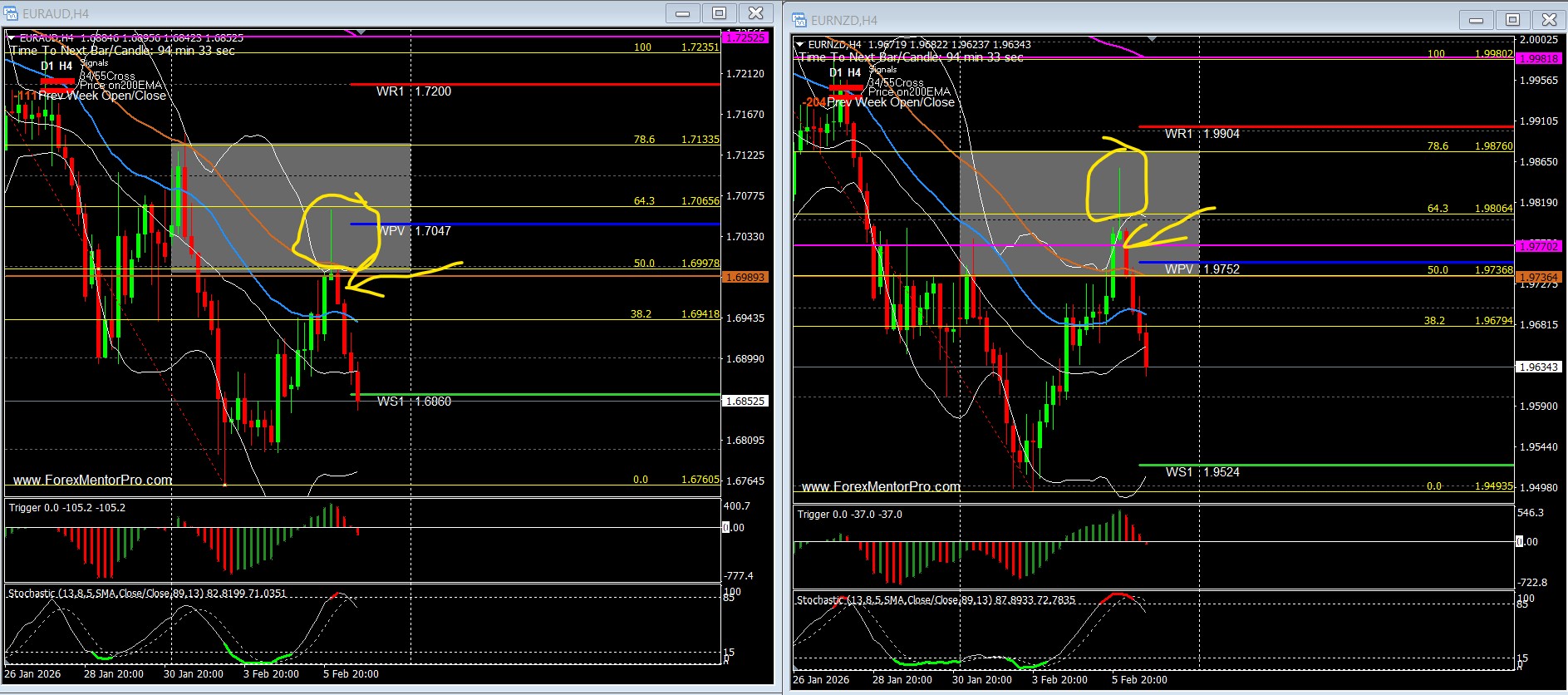
Last week provided a “textbook” example for currency traders watching the Euro crosses. If you were tracking EUR/AUD and EUR/NZD, you witnessed a perfect display of technical harmony. Both pairs didn’t just move in the same direction; they respected the exact same structural boundaries, hitting my “Earth and Sky short zones” simultaneously.
Here is a breakdown of how these pairs moved in lockstep and what this means for your trading strategy.
The Setup: Perfect Technical Convergence
Last week, both EUR/AUD and EUR/NZD reached critical overhead resistance levels— my “Earth and Sky short zones”.
The price action was almost identical:
Key EMAs: Both pairs pulled back into major Exponential Moving Averages (EMAs), which acted as dynamic resistance.
Resistance Confluence: These EMAs lined up perfectly with my “Earth and Sky short ” zones and weekly main pivot points.
The Signal: Just as they hit these short zones, both pairs printed clear reversal candles (look at that 4-hour candles on both – same resistance same wicks), signalling that the upward momentum had exhausted as sellers pushed price down at the resistance area and that is what formed the big wicks.
Because these two pairs were positively correlated, the short signal on one served as a powerful confirmation for the short signal on the other.
What is Positive Correlation?
In trading, positive correlation occurs when two currency pairs tend to move in the same direction.
In the case of EUR/AUD and EUR/NZD, the correlation is usually very high (often above +0.80).
This happens because:
The Base Currency: Both pairs share the Euro (EUR). If the Euro weakens globally, both pairs will likely fall.
The Quote Currencies: The Australian Dollar (AUD) and the New Zealand Dollar (NZD) are “commodity currencies” and “risk-on” assets. They are geographically and economically linked, meaning they often strengthen or weaken against the Euro at the same time.
How to Use Correlation in Your Trading
Understanding that EUR/AUD and EUR/NZD move together isn’t just a fun fact—it’s a strategic tool. Here is how a professional trader uses that information:
1. Enhanced Confirmation (The “Double Check”)
If you see a short setup on EUR/AUD but EUR/NZD is still charging upward without any sign of slowing down, you might want to wait. When both hit their “Earth and Sky short zones” and show reversal candles at the same time, your confidence in the trade increases significantly. It proves the move is driven by broad Euro weakness rather than a random spike.
2. Risk Management
This is the most critical part. Because these pairs are positively correlated, trading at the same time is essentially doubling your risk on the same trade.
If you short both for 2% of your account each, and the Euro suddenly spikes, you lose 4%.
Pro Tip: Pick the pair with the “cleanest” price action or the best risk-to-reward ratio, rather than over-leveraging across both.
3. Gauging Market Strength
Correlation helps you identify the “leader” and the “laggard.” If EUR/AUD hits the resistance zone and starts dropping while EUR/NZD is lagging behind, the laggard (EUR/NZD) often offers a “second chance” entry to catch the move before it follows suit.
The Bottom Line:
Last week’s performance was a reminder that the market isn’t a series of isolated events. By watching how EUR/AUD and EUR/NZD reacted to their respective “Earth and Sky short zones”, traders could see the big picture. When correlation, EMAs, and price action align, the “Earth and Sky” is truly the limit for potential profits.

NOW LOOK AT THE 4 HOUR CHARTS – CAN YOU SEE IT?
- Earth and Sky short zones.
- Main weekly pivot points.
- EMAs – on the one a 55 and on the other a 55 and a daily 200 EMA.
- Look at both 4-hour candles with the big wicks (bearish pin bar at resistance) ……followed by a red candle……
- Overbought stochastics.
Now for homework
Pop us a note in the forum why you think Ashley wanted to take the short on the Euro/NZD pair instead of the Euro/Aussie pair.
Hope you learned something today
Regards
Pierre